Parking Spot for Rent: What to Check Before You Sign
The short version
- A parking spot for rent should match your vehicle’s real dimensions, not just a generic “car-sized” label in the listing.
- Access hours matter as much as the price, especially if you work early shifts, late shifts, or keep odd hours.
- Lighting and visible security cut your risk of a break-in, a dent from a shopping cart, or a slashed tire.
- Overhead and side clearance decide whether your vehicle actually fits, not just whether it parks.
- Get towing rules and key or fob arrangements in writing before you sign anything.
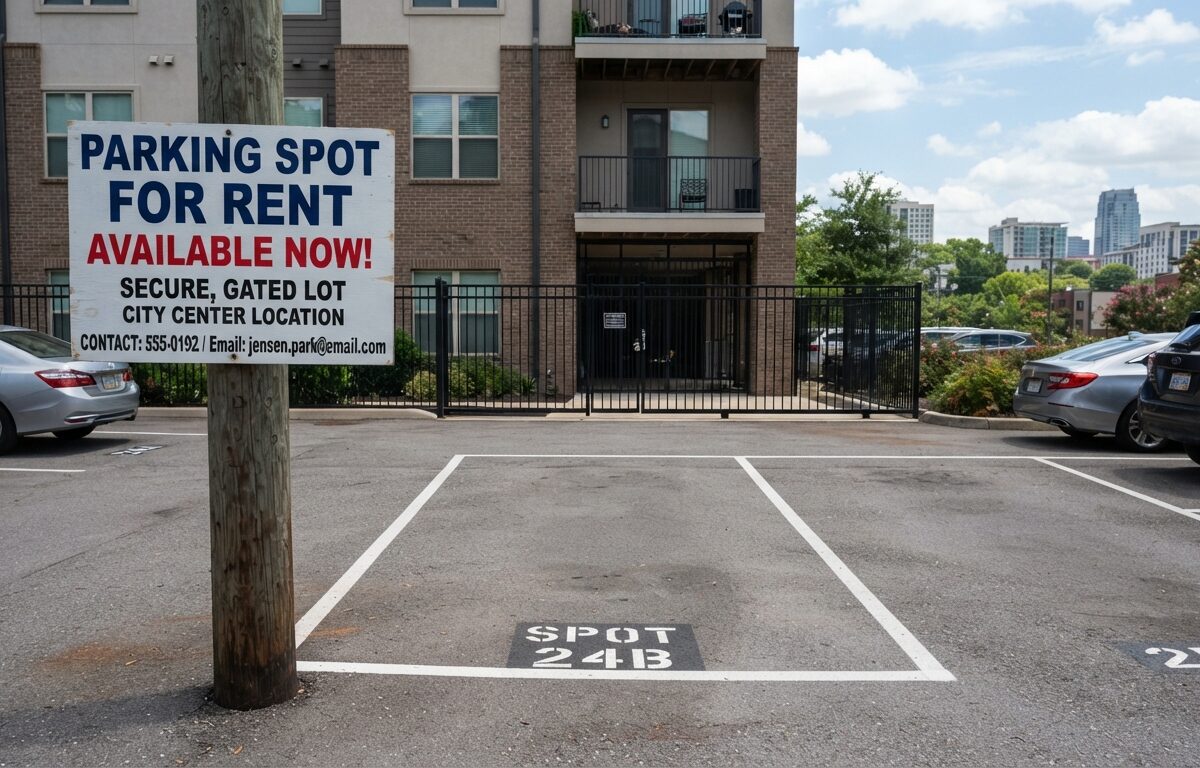
A parking spot for rent looks the same in almost every listing photo: a rectangle of pavement with a number painted on it. What the photo won’t show you is whether your truck clears the low beam in the garage, whether the gate opens at 5 a.m., or who can order a tow if you’re ten minutes late moving your car on cleaning day. Before you sign a lease for a parking spot for rent, walk the space in person and check six things that matter more than the monthly rate.
Measure the Space, Don’t Just Eyeball It
Bring a tape measure. Private spots, especially converted driveways, garage bays, and older buildings, often run smaller than a standard commercial stall. New York City’s zoning code sets a minimum of 18 feet long by 8 feet 6 inches wide for a standard parking space, and that’s a useful baseline even outside New York, because plenty of private spots don’t meet it. If you drive a full-size truck, an SUV with a roof box, or anything longer than a mid-size sedan, measure your vehicle’s actual length and width (your owner’s manual usually lists it) and compare it against the space, not against the word “car” in the ad.
Check the Access Hours Before You Check the Price
A cheap parking spot for rent that locks its gate at 10 p.m. isn’t cheap if you get home at midnight. Ask directly: what are the access hours, is there a keypad or fob for after-hours entry, and what happens if the gate jams on a Sunday. Some garages restrict access during cleaning or maintenance windows. Some private driveways are only available when the homeowner is themselves away. None of this shows up in a listing photo, so ask before you commit, not after your car gets stuck outside a locked gate.
Walk the Space at Night, Not Just During the Day
A lot that looks fine at 2 p.m. can feel very different at 10 p.m. Look for working lighting over the space itself, not just at the entrance. If it’s an outdoor lot, check whether it’s visible from the street or tucked behind a building where nobody would notice a break-in. If it’s a structure, check for cameras and whether they’re actually pointed at your row. None of this guarantees nothing will happen, but a well-lit, visible spot is a meaningfully lower risk than a dark corner.
Confirm Overhead and Side Clearance
Height matters for trucks, vans, SUVs with roof racks, and anything towing a small trailer. Covered spots and garage levels post a clearance height somewhere, usually at the entrance ramp. Find it and compare it to your vehicle’s actual height with anything mounted on top. Side clearance matters too, especially in narrow driveway spots or tight garage bays where you need room to open your doors or load groceries without scraping the car next to you.
Get the Towing Rules in Writing
Ask who can order a tow, under what conditions, and which company they use. Some states require a posted sign at the entrance before a private lot can legally tow a vehicle, so look for one near the driveway or ask the owner directly. Get clear on the specifics that actually trip people up: how long you can be late moving your car on a cleaning day, whether guests can use your spot temporarily, and what happens if you’re blocked in by someone else’s vehicle.
Find Out Who Holds the Keys or the Fob
If the space is gated, ask how many fobs come with the rental, what a replacement costs, and who to call if the fob stops working at 11 p.m. on a Friday. If it’s a locked garage bay, ask whether the owner keeps a spare key and under what circumstances they’d use it. This sounds like a small detail until you’re standing outside a locked gate with nobody answering the phone.
Bring a Short Checklist to the Walkthrough
You don’t need anything fancy. A tape measure, your phone camera, and five minutes of your time will catch most problems before you sign. Photograph the space, the entrance gate or door, any posted signage, and the surface itself. Cracked pavement, standing water after rain, or a steep slope into a driveway spot are all things you’ll want on record if a dispute ever comes up later. Take the photos with a timestamp, and keep them alongside whatever written agreement you end up with.
FAQ: Parking Spot for Rent
How big should a parking spot for rent be for an SUV or pickup truck?
Look for at least 9 feet of width and 20 feet of length as a rough minimum for a full-size SUV or pickup, and measure your specific vehicle rather than trusting a general label. Add a few inches of buffer for mirrors and door swing.
Can a landlord change the access hours after I’ve signed a lease?
It depends on what your written agreement says. A lease that specifies 24/7 access is harder to change midterm than a casual month-to-month arrangement with no written hours at all, which is exactly why you should get the hours in writing up front.
What should I put in writing before renting a spot?
At minimum: the monthly rate, access hours, number of keys or fobs provided, towing policy, and notice period for either side to end the arrangement. A short written agreement protects both you and the owner.
Ready to compare real listings with real dimensions and access details instead of guessing from a photo? Browse current parking spaces for rent or search options near you on our listings page. If you’ve already found a spot and want a second opinion on the agreement, our guide to what a parking rental contract should say is a good next stop, or you can contact us directly with questions.
Leave a Reply